


Systemic Perspective
Systemic work is best known for family constellations under the name Bert Hellinger. Incidentally, Hellinger was mainly inspired by the Hungarian Iván Böszörményi-Nagy and his contextual family therapy. Ivan Boszormenyi-Nagy was aware of invisible bonds within a family and hidden loyalties. He realized that there had to be a balance between giving and receiving.
“Whether we are aware of it or not, a great deal of our suffering is not caused by what we have personally experienced, but what others in our system have experienced or suffered.”
“Whether we are aware of it or not, a great deal of our suffering is not caused by what we have personally experienced, but by what others in our system have experienced or suffered.”
(Hellinger 2001a, p. 434).
It has been gaining popularity in the Netherlands for a number of years. The underlying theory and way of thinking provides even more insights. In addition to doing a constellation, there is also a lot you can do yourself.
“Every person has their own story that wants to be lived.”
Wibe Veenbaas in Vonken van Verlangen 1.1
Put these insights to work for yourself. Click on the link below for more information on writing your own life story.
#Levensverhaal – Analyse your own familysystem!
Analyzing your family system is an important step in spiritual awakening.
#Spiritual Awakening
Een Alknowing Field?
The “omniscient field” is like a powerful and universal field of energy and information that encompasses everything and everyone. A non-local, shared information domain that structures patterns of experience and behavior and is accessible outside the conscious knowledge of the individual.
Although there is still much uncertainty about its exact functioning, there are several theories that point to the same thing. Namely, an invisible connection that you can make and experience at any moment with other people, living or dead. Other souls is perhaps a better way of putting it.
It is remarkable that in a family constellation, I or you can be placed in the position of a completely unknown person and then feel and experience the dynamics or the feelings that person has in that position. As soon as you step out of the constellation, that feeling disappears.
What comes closest to me is Rupert Sheldrake’s explanation or theory about morphic fields. Another therapist who points in the same direction is Carl Jung with his collective unconscious.
Rupert Sheldrake – morphic resonance, patterns and behaviors can develop in a collective consciousness; this information can be transferred to future generations and individuals. All living beings, including humans, are connected to this field and carry information within it that is the result of their experiences and history.
Carl Jung keek in dezelfde richting met het Collectief Onbewuste. “Hij definieerde het collectieve onbewuste als een gedeelde, geërfde psychische laag die universele patronen (archetypen) uit de voorouderlijke menselijke ervaring bevat, onderscheiden van persoonlijke herinneringen, en stelde dat het een “deel van de psyche is dat negatief kan worden onderscheiden van het persoonlijke onbewuste door het feit dat het, in tegenstelling tot het laatste, zijn bestaan niet te danken heeft aan persoonlijke ervaring… de inhoud van het collectieve onbewuste is nooit individueel verworven, maar dankt zijn bestaan uitsluitend aan erfelijkheid”. Het is een reservoir van oerbeelden en instincten, dat het psychische erfgoed van de mensheid vormt en tot uiting komt in universele mythen en symbolen.”
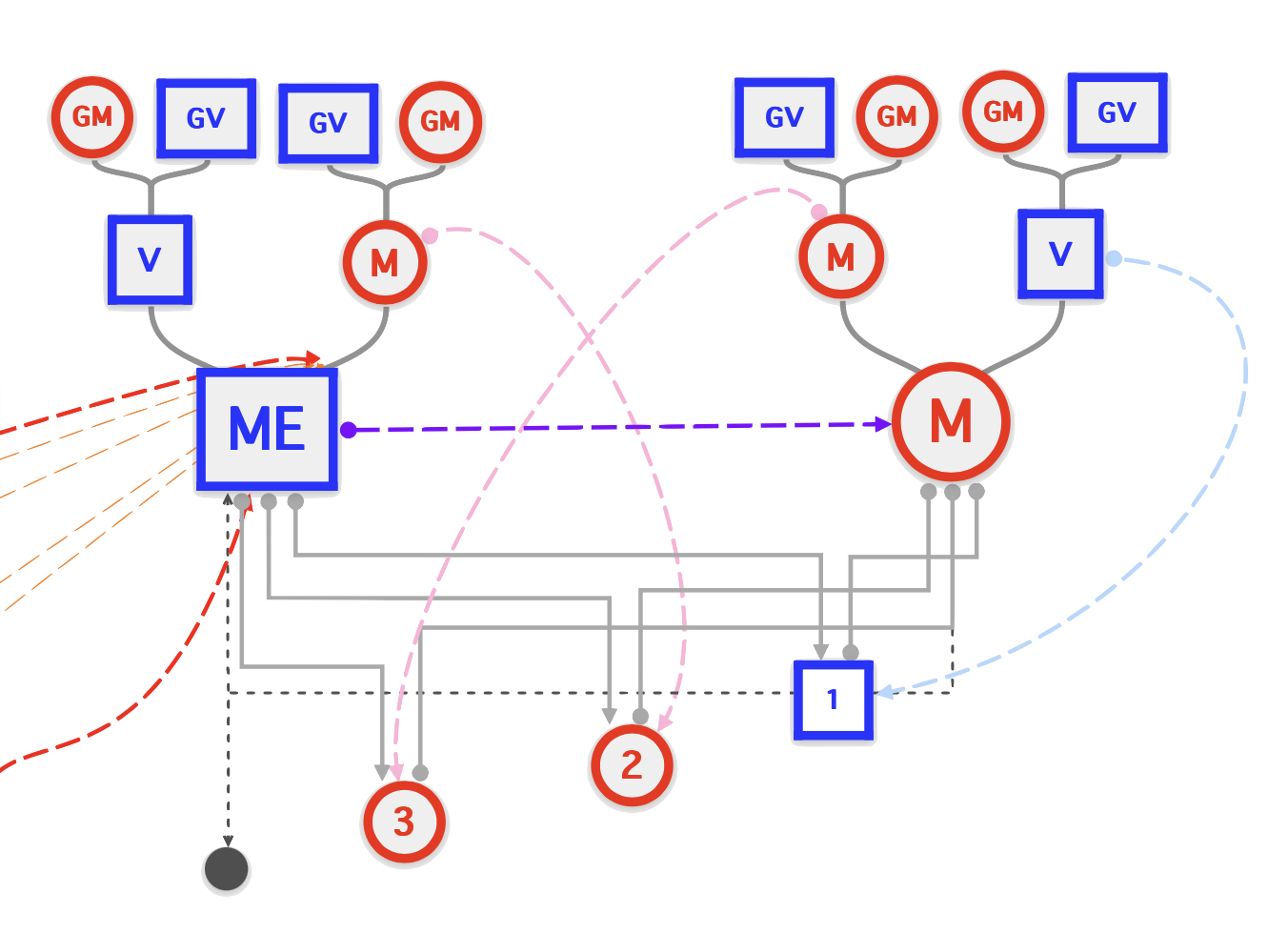
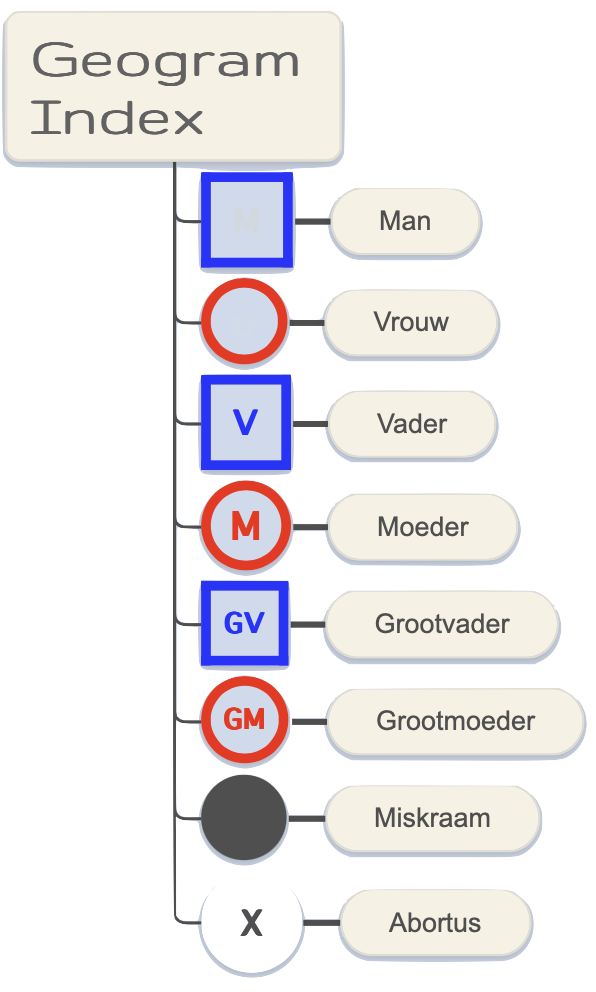
Paterns
So what are these patterns? Within this field, there is often talk of the male and female lines.
I see it differently. Within a family, children often resemble their father and then their mother (an abortion or miscarriage can disrupt this process). The way in which this is passed on systemically is through the parent whom a child resembles, and then the strongest connection seems to be with the grandparent of the same sex on that side of the family.
I resemble my mother more than my brother resembles my father. So I am systemically connected to the grandparent of the same sex on that side of the family. That is my mother’s father. The parallels in his life and mine are numerous.
This also applies to my partner, who resembles her father more. For her, there are many parallels with her grandmother, her father’s mother.
Discovering patterns does not mean that you have no choice. You can cherish what you value in the life of that grandparent and consciously decide to take a different course in other aspects. So that you don’t end up in the same place if you don’t want to.

The Order of Things
The individualistic philosophy of life in the West sometimes finds it difficult to reconcile with certain predetermined aspects of life and the world. There are a number of characteristics of the order of things in a family system that are important.
There is an order present, regardless of the order that humans create. Just like laws. In addition to man-made laws, there are the laws of nature and those of the universe. In the same way, there is also a system, an order of nature and of the universe.
Oldest, Youngest, and Middle Child
When you are born, you are either the oldest, the youngest, or a middle child. This position in the family has certain characteristics that are universal.
In some respects, an eldest child has more in common with another eldest child in a different family than with his or her younger siblings. Often, this position has both advantages and disadvantages, as does the position of the youngest or middle child.
Head of the Family
In many Western countries, family ties have weakened, and there is hardly any hierarchical structure within a family, as was often the case in the past. The eldest (in many cultures, only the eldest man) became the head of the family. That position used to have an important function that seems to have been completely diluted; this function has not adapted to the times.
Systemic Wounds
There are a number of wounds that people can suffer or cause. This can happen, for example, when a child is caught between divorcing parents, or when the death of a parent means that the child has to take on some of that parent’s roles. This creates an unhealthy dynamic and prevents the child from being a child. This affects their further development and needs to be healed.
Other “systems” you might be related to
In addition to the family system, where everyone has a place and is connected to their ancestors, there are many other systems where people have a place and are connected.
This could be a religion or another organized group, for example.
In any case, everyone is also part of a larger group that largely corresponds to the race or original culture to which they belong and have belonged for generations.
For example, white Western men have a very different systemic baggage than Asian men, for example. The former have an “overdose” of masculine, dominant, patriarchal energy that resonates with a colonial past. The latter have much more of a feminine, accommodating energy that seeks harmony. Of course, there are exceptions to this, so don’t take the above as a definitive label. But look for where the challenge lies for you. In the case of the above example, it may be a challenge to accommodate someone else or, conversely, to stand up for yourself and set boundaries. To answer a question with a clear NO. Once you are clear about this, make a move to the other side. Practice taking on a different role.